
The Core Reset: Why Your Foundation is More Than Just "Abs"
- Shamim Khan

- Apr 21
- 2 min read
Most of us have been taught that a "strong core" is synonymous with a flat stomach or the ability to hold a plank for five minutes. But if you’ve ever had back pain "even though you are fit" or that can't be attributed to and injury - you've probably had the "core conversation" with your physio. The core is frequently mischaracterised as a superficial muscle group defined by aesthetic visibility. In clinical practice, however, we view the core as a sophisticated, integrated motor system. It is the body’s central stabilisation unit, orchestrating the force transfer between the upper and lower limbs and providing the foundational support necessary for all functional movement.
Understanding this system is critical for addressing persistent spinal load and optimising physical recovery.
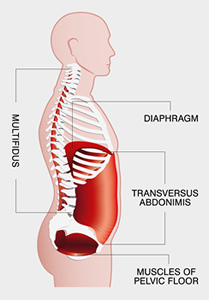
The Biomechanics of Core Stabilisation
Physiologically, the core functions as a pressurised, multi-segmented canister. The diaphragm acts as the ceiling, the pelvic floor as the floor, and the deeper abdominal and back muscles as the walls.
Intra-Abdominal Pressure (IAP): Stability is achieved when these components function in sequence to regulate internal pressure. This pressure acts as a biological brace, mitigating excessive spinal loading during everything from lifting a heavy box to simply sitting at your desk.
Dynamic Support: The core’s primary role is not to generate movement, but to limit it where necessary, providing a stable platform for the limbs to generate force efficiently.
Why "Timing" Trumps Strength
We often see patients who can perform dozens of crunches but still struggle with lower back pain. The research points to a clear reason: neuromuscular timing.
In a healthy state, your nervous system triggers core contraction milliseconds before you move a limb—this is known as "feed-forward control." When you are sedentary, stressed, or recovering from an injury, this timing often becomes sluggish. Your core is firing, but it’s firing too late to protect your spine. This is why "more exercise" doesn't always help; it’s about retraining the communication between your brain and your stabilising muscles.
Moving Beyond "Core Strength"
The evidence suggests that effective core function is less about the magnitude of muscular force and more about the precision of timing and integration. If you are experiencing recurring discomfort or feel that your movement is restricted, the issue may not be a lack of strength, but a need for better neuromuscular synchronisation.
A structured assessment at KSN Physiotherapists can help identify these timing delays, moving you away from generic "core workouts" and toward a targeted retraining program designed to restore your functional foundation.
References
1. On Intra-Abdominal Pressure (The "Canister" Model) Arjmand, N., & Shirazi-Adl, A. (2006). Role of intra-abdominal pressure in the unloading and stabilization of the human spine during static lifting tasks. European Spine Journal, 15(8), 1265–1275. PMID: 16333683; PMCID: PMC3233951.
2. On Athletic Function and Integration Kibler, W. B., Press, J., & Sciascia, A. (2006). The role of core stability in athletic function. Sports Medicine, 36(3), 189–198. DOI: 10.2165/00007256-200636030-00001.
3. On Neuromuscular Timing and Back Pain Hodges, P. W., & Richardson, C. A. (1998). Delayed postural contraction of transversus abdominis in low back pain associated with movement of the lower limb. Journal of Spinal Disorders, 11(1), 46–56. PMID: 9493770.


Comments